

 English
 中文简体
 عربى
 Español


what is a driveline: Applications, Selection Criteria, and Practical Guidance
Posted by Admin | 16 Oct
Content
A front-wheel-drive car carries torque from the transmission to the tires through roughly a dozen parts: two half shafts, four constant-velocity (CV) joints, two rubber boots, two hub bearings and the fasteners that hold them in alignment. Most drivers never think about any of it — until a slow turn produces a rhythmic click, or a highway cruise sends a vibration up through the floor pan.
A driveline is the complete set of components that transfers torque from the transmission output to the driven wheels. That covers shafts, joints, yokes, bearings, boots and the housings that keep them aligned. If the transmission decides how much torque to send, the driveline decides whether that torque reaches the tire smoothly, quietly and at the right angle.
The boundary matters commercially. A buyer who orders "a driveshaft" for a front-wheel-drive car usually needs a half shaft with two CV joints; the same request for a rear-wheel-drive truck needs a one- or two-piece propeller shaft with a slip yoke. Confusing the two is the most common sourcing error in this category.
Driveline vs Drivetrain vs Powertrain: Where the Lines Fall
The three words get used interchangeably in repair bays and parts catalogs, and the overlap causes genuine confusion when a mechanic, a catalog manager and a design engineer are looking at the same vehicle. The cleanest way to separate them is by scope, from widest to narrowest.
| Term | Scope | Typical parts included |
|---|---|---|
| Powertrain | Everything that generates and delivers motive power | Engine or electric motor, transmission, drivetrain |
| Drivetrain | Everything after the engine that puts power to the wheels | Transmission, transfer case, differentials, driveline |
| Driveline | The mechanical path from transmission output to the driven wheels | Propeller shaft, half shafts, CV joints, U-joints, yokes, boots, hub bearings |
Most service literature accepts that nesting, but not all of it does. Some OEM manuals treat the transmission as part of the driveline; others stop the driveline at the pinion flange. That difference changes which part numbers a customer expects, so confirm the definition in their own documentation before quoting.
The Main Driveline Components and What Each One Does
Every layout — front-wheel drive, rear-wheel drive, all-wheel drive — solves the same five problems: transmitting torque, absorbing angle change, absorbing length change, supporting rotation, and keeping grease in while grit stays out. We break down the components of a driveline in more detail elsewhere; the hardware that does the work is listed below.
- Propeller shaft (prop shaft): carries torque along the length of a rear- or all-wheel-drive vehicle. It is balanced as a complete assembly, because a few grams of imbalance shows up as a vibration at one specific road speed.
- CV joints: transmit torque through changing angles at constant velocity. Outer joints handle steering angles of roughly 40 to 45 degrees; inner joints handle suspension travel and plunge.
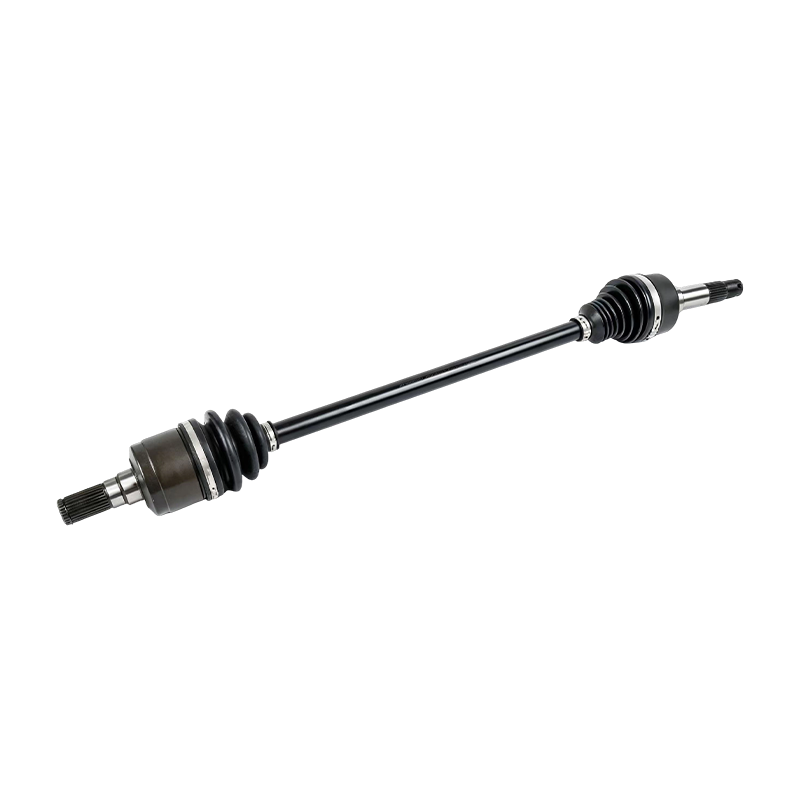
- Half shafts (CV axle assemblies): the pair of shafts that carry torque from a transaxle to each driven wheel, with one joint at each end.
- Universal joints and yokes: the simpler, lower-cost joint used mainly on propeller shafts, where angles stay small and the joint never steers.
- Slip yoke or plunge joint: allows the shaft to change length as the suspension moves. Its splines carry full torque, so wear shows up as a clunk during load changes.
- Carrier or support bearing: holds a two-piece shaft steady at the centre joint and takes the runout out of a long shaft.
- Differential and pinion: the final reduction, and the point where torque is split between the left and right wheels.
- Boots and seals: the cheapest parts in the assembly, and the ones that decide how long the joints last.
- Hub and wheel bearings: position the wheel end, carry vertical load and set the rotating reference for the ABS sensor.
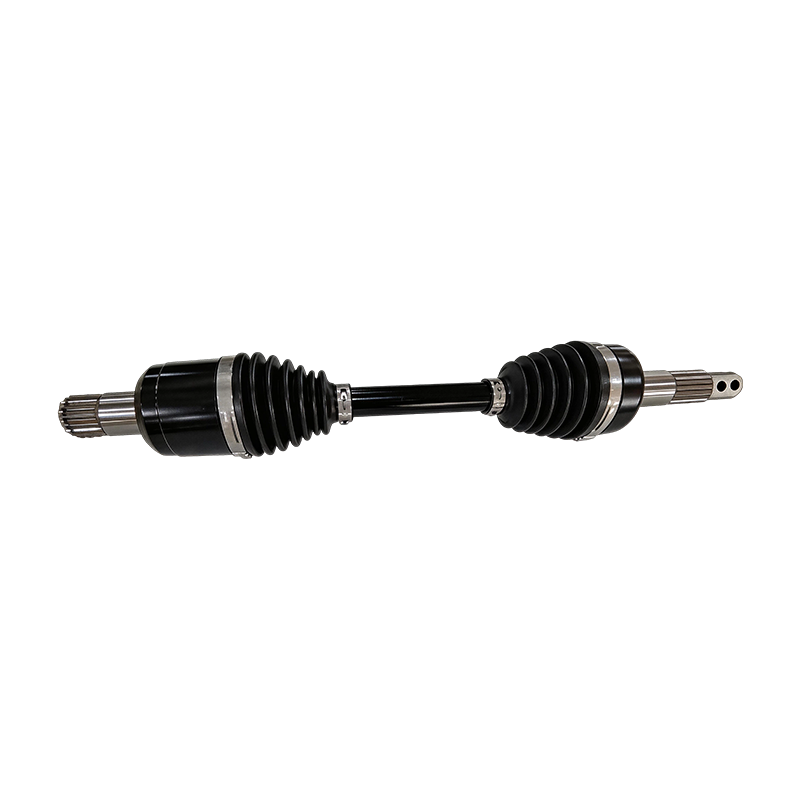 OE-Standard CV Axle Assembly and Drive ShaftAppears as the hardware example after driveline layout differences: OE-standard alloy-steel construction, dynamic balance, and broad vehicle compatibility for replacement or custom use.View Product →
How the Driveline Changes With FWD, RWD and AWD
The functions stay the same; the hardware and the number of joints change with the layout and with where the engine sits.
Front-wheel drive
A transaxle sits beside the engine and sends torque to two half shafts through CV joints at both ends. Because packaging is tight, the two shafts are different lengths; the longer one often runs through an intermediate shaft and a support bearing to keep vibration under control.
Rear-wheel drive
Torque leaves the transmission through a slip yoke, travels down one or two propeller shafts and enters the rear differential through a pinion yoke. A two-piece shaft adds a centre support bearing and a second U-joint. U-joints work efficiently here because the angles are small and the joint never has to steer.
All-wheel drive and 4WD
A transfer case splits torque front and rear, so the driveline grows a front propeller shaft and a second differential. More joints mean more places for imbalance to appear, which is why a complete assembly should be balanced as a unit rather than part by part.
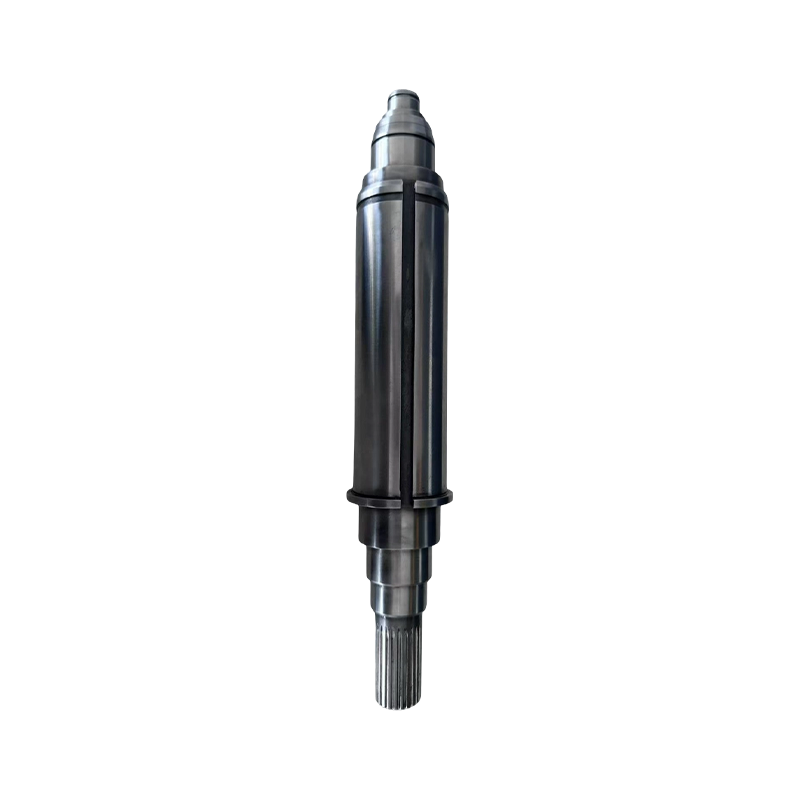
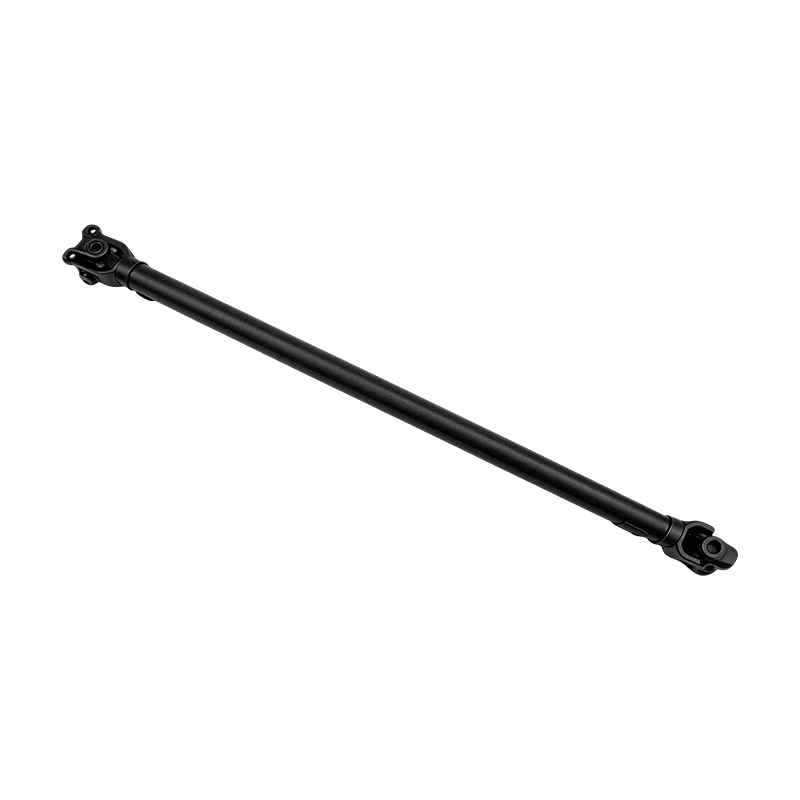 Intermediate Prop Shaft Assemblies for DrivetrainsPlaced after transfer-case torque split and before CV boot failure notes, this balanced alloy-steel shaft assembly addresses NVH, torque steer, and high-torque driveline loads.View Product →
Where Drivelines Actually Fail
In real service, the rubber usually fails before the steel. A CV boot splits, grease escapes, grit enters, and the joint follows within a few thousand kilometres. We covered how important dust boots are in a separate teardown; the short version is that a boot kit costs a fraction of a joint replacement, and the labour is nearly the same.
- Rhythmic clicking that follows steering angle at low speed: outer CV joint wear.
- Vibration in a narrow speed band, often 60 to 90 km/h: shaft imbalance, a worn U-joint, or a shaft that has taken an impact.
- Grease sprayed inside the wheel arch or onto the subframe: split boot, with joint damage usually already starting.
- A clunk when the driver lifts off or reapplies throttle: slip yoke or spline wear, though worn engine and transmission mounts imitate the same noise.
- A hum that changes when the car is loaded side to side: hub bearing rather than joint.
Separating these cases early is worth the diagnostic time, because a bearing replaced in place of a joint — or the reverse — doubles the labour cost for the same repair.
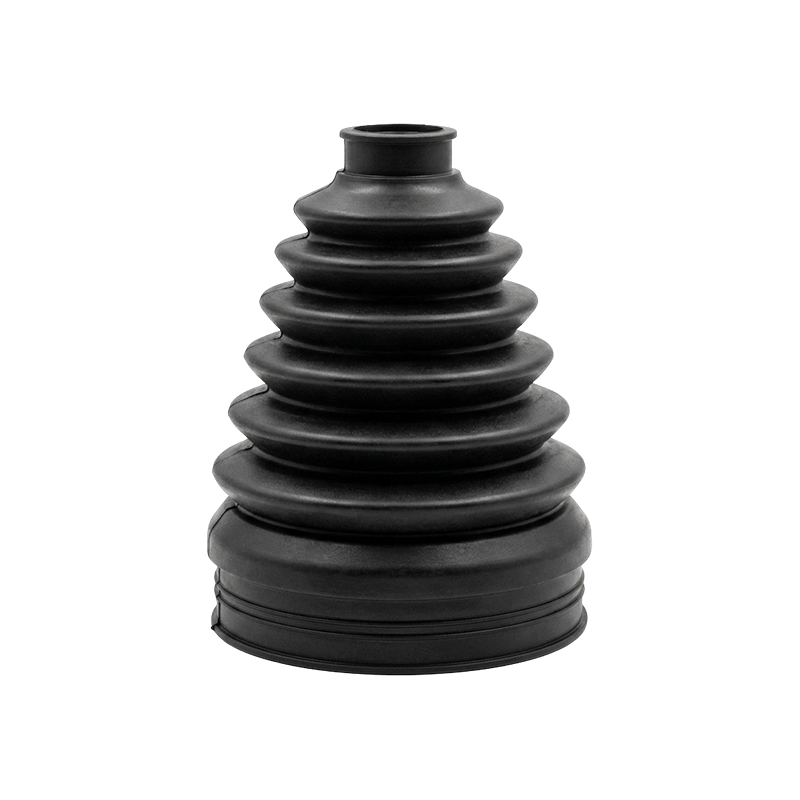
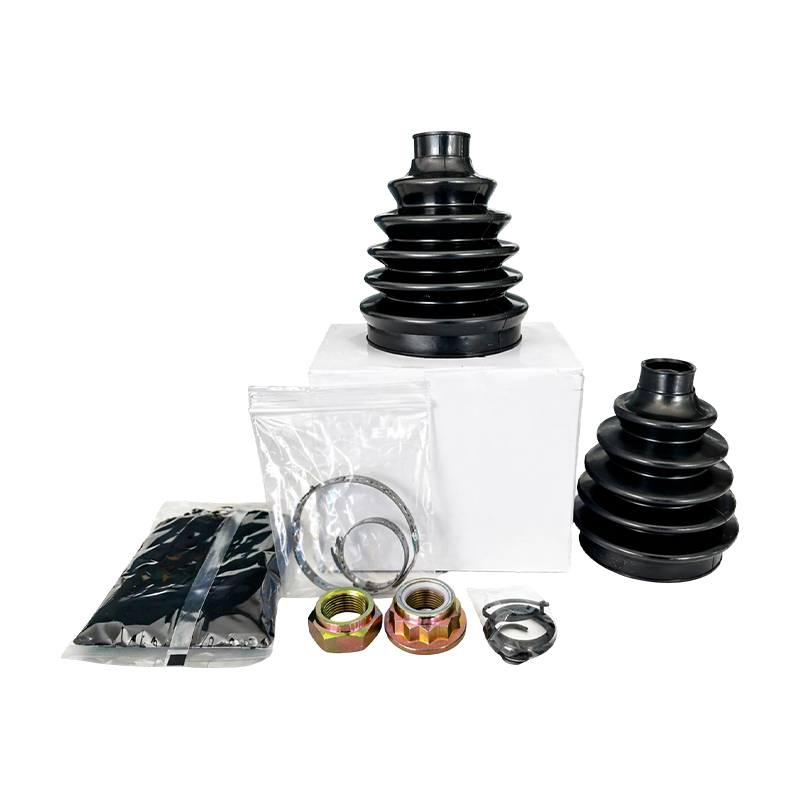 OEM-Grade CV Boot Repair KitsFor diagnostics that separate seal failure from joint wear, this all-in-one kit includes boot, MoS2 grease, clamps, and OE-matched fasteners for zero-error installation.View Product →
What to Verify Before Buying Driveline Parts
For buyers, distributors and design engineers, the risk is rarely "will it fit the car". The risk is "will it fit this exact build". These are the checks that prevent returns and warranty claims.
- Spline count and major diameter. Count the teeth and measure the outside diameter — a 28-tooth shaft is not a universal fit, and a 1 mm diameter difference will not seat.
- Joint type and dimensions. Inner tripod joints and inner ball joints are not interchangeable. Check joint diameter, boot groove spacing and circlip position.
- Boot material and grease compatibility. CR (chloroprene) resists ozone and holds up against standard CV grease; thermoplastic boots tolerate higher angles but must not be packed with the wrong lubricant.
- ABS or ESP tone ring. Confirm tooth count and press fit. A missing or damaged ring sets a wheel-speed code that reads like a brake fault.
- Length and travel. Measure compressed and extended lengths on the vehicle, or work from the OEM drawing. Plus or minus 1 to 2 mm on a critical length is usually the ceiling for a drop-in fit.
- Balance specification. Ask for residual imbalance in g·mm and a balance report on propeller shafts. Balanced assemblies cut vibration claims sharply.
- Traceability. For OEM and aftermarket programs, request rubber compound, hardness (Shore A) and heat-treatment records per batch so any claim can be traced back to a production lot.
None of these checks is exotic, but skipping any one of them is how a well-priced order turns into a shipment of parts nobody can install.
A driveline is the torque path from the transmission output to the driven wheels: shafts, joints, yokes, bearings and the boots that protect them. It behaves as a system rather than a single part, which is why one split boot can write off an otherwise healthy CV joint.
Whether the question comes from a driver hearing a click on a slow turn or from a purchasing team aligning a new part number, the answer starts in the same place: identify the layout, identify the joint, then match dimensions, material and balance before comparing price.
MAIL US
CONTACT US
+86 133 0665 0391
MAIL US
No. 169 Songpu Road, Cidong Industrial Zone, Cixi City, Ningbo City, Zhejiang Province, China
 OEM/ODM Automotive Chassis Sealing Components Manufacturer
EV Drivetrain Components Supplier